Sunday, December 9, 2012

Crimson Waters Cause Several Sydney Beaches To Close

Crimson Waters Cause Several Sydney Beaches To Close
By Meera Dolasia
http://www.dogonews.com/2012/11/30/crimson-waters-cause-several-sydney-beaches-to-close

On Tuesday November 26th, World famous Bondi beach in Sydney's blue ocean water has turned *crimson red! They are an algae called noctiluca scintillans. 

       This crimson red water was caused by recent hot weather and heavy rainfalls in Sydney. This natural phenomenon also happened in the oceans around California. Noctiluca scintillans causes skin rashes, eye irritations, and the thick algae kills micro organisms and cause low oxygen in the area, causing marine animals in the area to die. Except for the skin rashes and eye irritations, they are no harm to humans. Fortunately, this phenomenon won't last that long. 
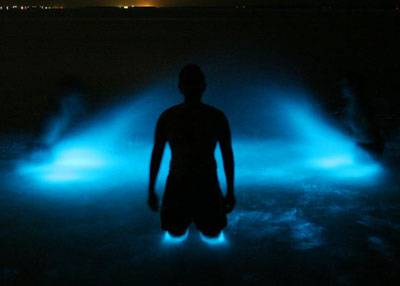
      Even though during the day, it looks red and scary, but at night, it glows electrical blue which normally should be dark. In California, surfers uses this fascinating characteristic and surfs at night. But why does it glow? The organisms become *bioluminescent caused by a chemical reaction that happens when the organisms shove/push each other in the ocean waves.


*Crimson: deep red (when scarlet is bright red)
*Bioluminescence: production and the act of releasing the light by a living organism


ASIMO

The article "I, Robot- Are Real Androids Ready for Their Close-Up?" by National Geographic describes about future robots and the humanoid robot, ASIMO. ASIMO, created by Honda,  is a 4 foot-tall robot that looks like a fatter version of the stormtroopers from Star Wars. ASIMO stands for Advanced Step in Innovative Mobility. ASIMO can do all sorts of things like humans can. He can climb stairs and even balance on uneven surfaces. Sony claims that their humanoid robot (QRIO) is the world's first running humanoid robot, however, ASIMO is now doing tours all over the world.    Scientists think that in the future they could make robots that can help patients, serve them food and drinks and administer medicines. They could also do dangerous things for humans like moving chemicals and fighting fires.

I chose this article because it seemed really interesting and it is not too long ago. I mean, just think about it.  A long time ago people were dreaming about this and now we have it. Last year I did a Current Event project that was about an endangered rhino and I checked on National Geographic because it has great reputation and is a known and reliable source. I think it could be good  for society because we can program these robots to follow certain rules and soon they could be driving for us in a safer way.

Batteries Powered to Heal


Battery Capsles

Author: Stephen Ornes
Date: April 7, 2011
Batteries have limits. When a battery is charged up and used, some parts of the battery break down. For example, small cracks can form up inside the battery, blocking the flow of an electric current. This shows why a laptop battery will start to last less, sometimes even stopping to charge at all. Batteries could survive longer if we could heal the cracks. And that’s the idea for the new type of battery. In February, at the biggest general science meeting in the United States, an engineer called Scott White had an idea for a new invention:  A battery that can heal itself. Scott White and his colleagues knew that the small cracks, which often come up in the anode, can block the electric current and soon kill a battery. To fight the cracks, they added something extra into the anode: small plastic bubbles, or spheres, filled up with something called gallium indium. When the anode develops the small cracks, some of these bubbles break open and spill out the gallium indium. This material can heal up the crack, so that the battery can work properly and conduct electricity again.

When is a Rock Like a Magnet?


When is a Rock Like a Magnet?

Author: Sid Parkins
Date: September 28, 2012
 http://www.sciencenewsforkids.org/2012/09/making-rocks-into-magnets/
When it's a lodestone? New research by geologist Charles Aubourg and his colleagues at the University of Pau shows that, when heated, certain types of rocks can actually become natural magnets. The strongest and most common is the lodestone. This is because lodestone is made-up of a mineral called magnetite, which creates a persistent magnetic field. The rocks Aubourg and his team used when experimenting also contained small amounts of an iron-bearing mineral called pyrite. The experiment was a long process which included heating a rock inside a strong magnetic field for 25 days at 50 degrees Celsius, 25 days at 70 degrees, 25 days at 80 degrees, 10 days at 120 degrees, and another 10 days at 130 degrees.

A Light Delay


A Light Delay

By: Stephen Ornes
Date: January 12, 2012
 Researchers stored yellow light for more than a second, by means of an imprint left in some of the atoms (dark blue) in a cloud of ultracold sodium atoms (gray). The beam that emerges (bottom) has the same properties but is weaker than the original beam (
Scientists from Harvard University found out how someone can keep light. A women called Lene Hau, a physicist, knew how to keep light for 1.5 seconds. What she wants to find out is like the game when a person whispers something to another person's ear and the other person has to whisper the same thing to the last person and the last person has to say the thing that whispered the first person. So the light is like the first person whispering it to the BEC (The BEC-Bose-Einstein condensate- is the fifth type of Matter that you can only find in coldest place ever. When the strangest known materials are put in the temperate of 0 degrees all of the atoms collapse into one tiny blob, that's called the BEC).

Wednesday, November 21, 2012

A Squirt of Stem Cell Gel Heals Brain Injuries


Title: A Squirt of Stem Cell Gel Heals Brain Injuries
Author: Sandeep Ravindran
Website: http://www.popsci.com/scitech/article/2009-09/squirt-stem-cell-gel-heals-brain-injuries

Brain injured have always been one of the hardest body parts to cure. That is because brain injuries are very hard to fix. Since injured tissues swell up and can cause additional damage to the cells. Dr. Ning Zhang at Clemson University in South Carolina has created some sort of gel that can help cure the damaged injured tissues. "It has the potential to treat head injuries suffered in combat, car accidents, falls, or gunshot wounds." (Sandeep Ravindran) Since we do not have many ways to treat such damage scientists have tried inputting donor cells into the brain to replace the damaged ones. This however has not been working so well because, "The donor cells often fail to grow or stimulate repair at the injury site, possibly because of the inflammation and scarring present there. The injury site also typically has very limited blood supply and connective tissue, which might prevent donor cells from getting the nutrients they require." (Sandeep Ravindran) However the gel can be filled with chemicals that will help the donor cells get planted in the brain properly and receive the nutrients and blood needed to sustain and heal the injury. They have tested the gel on many different rats with severe causes of brain injuries and it has shown huge results. "Dr. Zhang loaded the gel with immature stem cells, as well as the chemicals they needed to develop into full-fledged adult brain cells. When rats with severe brain injuries were treated with this mixture for eight weeks, they showed signs of significant recovery." (Sandeep Ravindran) This gel might be something that will help us save many lives and the new pathway ahead. With the results we are getting now the gel might be ready to be tested on humans in about three years.

Wednesday, November 7, 2012

Quarter 2: Current Event 1


Helium: Not so super after all

An exciting discovery in physics turns out to be merely a case of mistaken identity"

              In 2004 scientist Moses Chan of Pennsylvania State University made a supernatural discovery. He discovered some sort of super solid that could flow without slowing down. He found a super solid that when cooled down to super cold temperatures could flow without slowing down, or without friction in other words. It appeared to not follow the law of friction which should not be possible. Ever since scientist have been calling such materials super solids. Ever since many scientists have been fighting to make the discovery their own. But now Chan has reported that the discovery is untrue, or in other words too strange to be true. He repeated his experiment and failed in proving his friction-free motion theory. The super solid that he thought was magical was actually a test material that became too stiff.  Chan told Science News he now feels “a sense of disappointment.”

             “Super solids were the latest super stuff to catch the interest of physicists, scientists who study matter and energy. Superconductors are materials that can carry electric currents without disruptions. Super fluids don’t obey the rules we’re used to; they may flow up and over the side of a container. Super solids would have been like super fluids, able to flow without friction.” Is what Chan told Science News in great disappointment. Friction is the force that slows down the motion of two touching things moving past each other. When you rub your hands together quickly, the heat you feel is from friction. Chan worked with one of his co workers Eunseong Kim on the first experiment. They used helium, which we usually use for blowing balloons. Like all matter, helium can exist as a solid, liquid or gas. Chan and Kim didn’t use helium gas; they used a solid form, which exists only at extremely low temperatures. They put the solid helium in a glass cylinder and put that in a device that twisted it one way and then the other, reversing direction 1,000 times per second.

             After that came the exiting part. Once the scientists lowered the temperature the cylinder began twisting faster. This increase in speed suggested some helium atoms had broken free of the solid and were acting more like a liquid, flowing without friction to slow them. That suggested some of the helium had transformed into a super solid. But in his team’s latest study, Chan found an error that he’d missed the first time around: A glitch in the construction of the twisting cylinder. And this mistake threw off the measurements. Although the error was tiny, it was large enough to confuse the researchers. What they had thought was a super solid turned out to be solid helium becoming stiffer.
Chan might not have found a super solid but he might have began a new era to find new things. Explore further and extend out limits. His findings, although mistaken were interesting and proving them impossible must have been the hardest action he has ever took.

http://www.sciencenewsforkids.org/2012/11/helium-not-so-super-after-all/